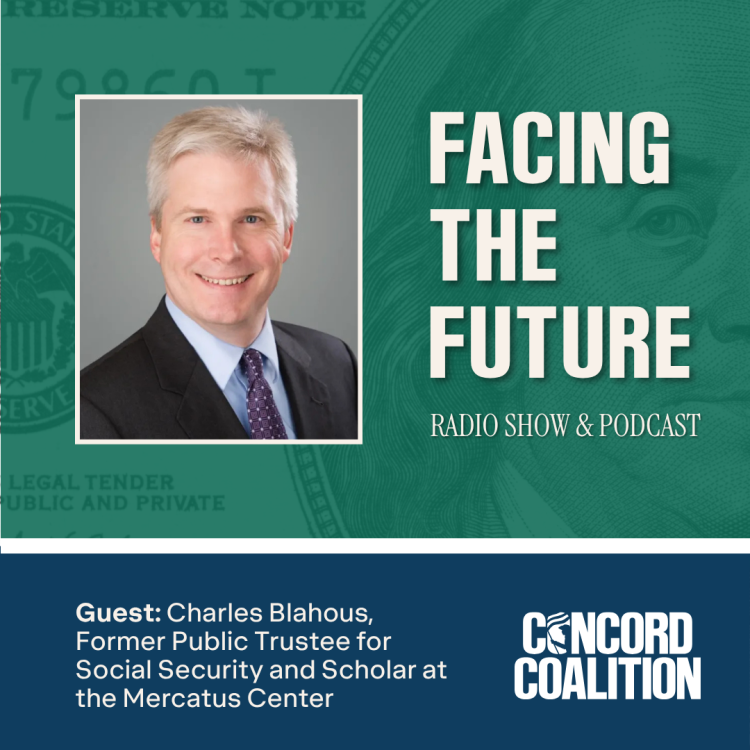
This week on Facing the Future, Capitol Hill budget experts Bill Hoagland of the Bipartisan Policy Center and Tom Kahn of American University join Concord Coalition executive director Dr. Carolyn Bourdeaux and host Bob Bixby to discuss how the Democrats’ major victories in the midterm congressional elections could affect the budget and the economy.
A frequent theme on this podcast is the need for policymakers to make big decisions, but on November 3 voters got to make a big decision of their own: Who shall control Congress? They chose a return to split control of government with Democrats retaking the House and Senate for the remaining two years of President Trump’s term.
Bourdeaux noted, “Even folks who were expecting a pretty significant blue wave were surprised at how deep and wide it was.” Hoagland, a former Senate Republican senior staffer, echoed this sentiment, describing the election as “a referendum on the president, more than anything else,” highlighting voters’ concerns over affordability issues and the war with Iran. While he acknowledged that Republicans took “a shellacking,” he cautioned Democrats “not to over-read this. It’s going to be tough sledding for the next two years with the president.”
Kahn, a former House Democrat senior staffer, explained that the Democrat’s winning campaign agenda focused on three key affordability issues: ending tariffs that raised consumer prices, addressing the war in Iran that impacted gas and food prices, and extending Affordable Care Act tax credits that had expired. “All three of those, if they’re enacted, will actually address the affordability crisis,” Kahn said. However, he noted, “The reality is they probably won’t be enacted, because I imagine President Trump will veto each one of them.”
Hoagland agreed with Kahn’s assessment but emphasized the need for Democrats to prioritize affordability over investigations into the administration. He said, “Democrats have to be very careful here that they balance affordability with what they want to do in the area of investigating the president and his family.”
Bourdeaux added some perspective on affordability, describing it as a “double-edged sword.” She noted, “I am sympathetic, as a former Democratic member of Congress, to their concerns about healthcare costs, about education, things like that. The challenge is, what they’ve often done, is paper over the cost. Instead of actually addressing the underlying cost increases, they instead provide a subsidy so that the individual consumer doesn’t feel the cost increase. But basically, it’s just our taxpayer dollars going to insurance companies or healthcare companies to cover the growing charges that they are passing along to all of us at enormous cost to the taxpayers. The challenge is that, if they try to do big spending bills without offsetting it, it might feel affordable to the taxpayer on the ground but it is not affordable because it runs up the debt, which then increases the interest rates, which then undermines the sort of economic affordability of homes, of cars, of many, many other goods.”
Before turning to a fiscal agenda for the new Congress in January, there is still essential work to be done in the lame-duck session beginning on Monday, November 9. The most pressing concern is government agency spending, which is currently funded by a continuing resolution that expires on December 11. Failure to pass full-year appropriations or a new continuing resolution before the deadline would result in the government shutdown.
Hoagland predicted a “very brutal lame-duck” with limited time to pass appropriations, a National Defense Authorization Act, and other key bills. He anticipated a short-term (CR) through March to keep the government running but warned, “There’s not a lot of time.”
Kahn added that Democrats would likely push for increased non-defense discretionary spending and provisions to limit controversial executive actions, reflecting a desire to reclaim congressional authority over the budget process.
The possibility of a government shutdown looms as a major concern. Hoagland emphasized the political risks: “If we have a government shutdown, do we have chaos for the next two years? That’s exactly what I think the American public were voting on yesterday. They don’t like the chaos.”
Bourdeaux underscored the tensions of the past two years over spending powers, describing the situation as “a low-grade constitutional crisis.” She explained, “One of the real challenges has been of the Trump administration is just absolutely running roughshod over all the rules that control how we budget, and where money goes, and how it’s spent. It’s made it very difficult for Congress to think it has any role whatsoever in budgeting. And the Democrats have been furious about this. My perception is that Republicans have also been very upset about it behind the scenes but did not want to confront the president. Now, they have an opportunity to straighten all of that out.”
On the use of reconciliation—a parliamentary tool that allows budget-related bills to pass with a simple majority and avoid a Senate filibuster—the panel expressed reservations. Kahn called the expansion of reconciliation to routine appropriations “very unhealthy to the congressional process,” as it undermines the bipartisan nature of appropriations.
Bourdeaux called on both parties to take up the mantle of fiscal responsibility, linking it to broader themes of affordability and economic strength. She suggested that Congress should enact a fiscal commission as part of its lame-duck legislation. “It’s going to be an interesting couple months,” she said, with much at stake for the nation’s fiscal and economic future.
Hear more on Facing the Future. Concord Coalition Senior Advisor Bob Bixby hosts the program each week on WKXL in Concord N.H., and it is also available via podcast. Join us as The Concord Coalition team discusses issues relating to national fiscal policy with budget experts, industry leaders, and elected officials. Past broadcasts are available here. You can subscribe to the podcast on Spotify, Pandora, iTunes, Google Podcasts, Stitcher, or with an RSS feed. Follow Facing the Future on Facebook, and watch videos from past episodes on The Concord Coalition YouTube channel.