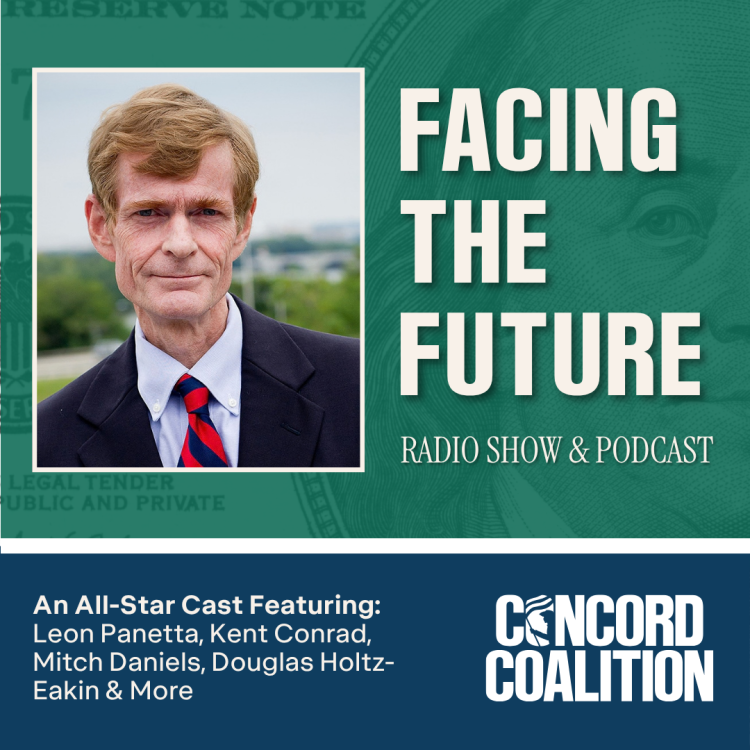
This week on Facing the Future, former CBO director Douglas Holtz-Eakin, now president of the American Action Forum, explains why problems in France’s bond market are a warning for the U.S. He also argues that the Federal Reserve should keep raising interest rates to fight inflation and describes the difficulty of projecting war costs during an actual conflict.
The so-called “Bond Vigilantes” have arrived in France. Investors are demanding substantially higher interest rates to lend to the French government, reflecting concerns about its large deficits, mounting debt and political failure to remedy the situation. People have begun wondering whether that is a warning signal to the United States.
“Well, I certainly hope that people interpret it that way,” Holtz-Eakin said. “They’re not identical situations, but there’s some things about the French numbers that should sound familiar. They have large budget deficits, about 5.5% of GDP. The U.S. deficit is 6% of GDP in the most recent year, so those look a lot alike. They have a lot of debt that’s very rapidly approaching 120% of GDP, above where the U.S. is. The U.S. is just north of 100, but big debts, big deficits.”
He noted, however, that the comparison is not exact. “The biggest difference between the U.S. and France at this point is, number one, the U.S. is growing, and it’s growing solidly. The third quarter looks to be doing real well. The French economy is dead in the water. So while you can think that some of the run-up in interest rates in the United States is due to demand for investment capital, you don’t have the same pressures in the French situation. And the second is, and this is the big lesson, we haven’t tried to fix our budget deficit. We haven’t done anything for a long time, actually. The French have tried twice and failed twice, and they’re on number three, and I think the bond market really is watching that. A continued political failure to come to grips with things is a bad thing. We could be in the same position not very long from now.”
Holtz-Eakin acknowledged that the U.S. benefits from having the dollar as the world’s reserve currency but warned, “That’s not, something that was handed down on stone tablets from Mount Sinai. That’s something that the U.S. earned, because we had impeccable credit, and the Treasury managed our finances, and there was no reason to ever question a timely payment of interest and principal. As time goes forward, if we don’t change our trajectory, there will be good reason to question the timely payment of interest and principal, and the dollar will no longer be the reserve currency. The only question is, at what point do the world capital markets lose faith in the United States? That’s hard to predict, and something you really don’t want to play with. That’s like playing with fire.”
Another major concern Holtz-Eakin discussed was inflation remaining stubbornly above the 2% target the Federal Reserve believes is in the best long-term interests of the economy
He suggested, “The key thing is to look at the Fed’s preferred measure of inflation, which is the personal consumption expenditures index (PCE), and look at the core measure of that, so take out these fluctuations in global oil prices. What you’ll see is that core PCE inflation has been at 3% for about 3 years. That’s the Fed’s problem. It has not gotten from 3% to 2% over 3 consecutive years, and it needs to do that. To me, that says monetary policy has not been restrictive enough, and they need to lean against it more heavily and get the number down to 2%, and do so relatively quickly to get their credibility back.”
Holtz-Eakin said this is particularly true given recent economic growth data. “Nominal GDP grew at an annualized rate of 8.1% in the second quarter. That is just really hot. That’s a lot of demand growth. You can’t have 8.1% growth and not be generating inflation pressure, so it’s time to take it down a notch, in my view.”
On the subject of projecting war costs, Holtz-Eakin related some lessons from his time as CBO director when the U.S. invaded Iraq in 2003. “The first thing I did was talk to the administration, and they said publicly, and they said to me with great seriousness and conviction, that it was going to cost $50 billion, and we would be out in less than a year. Then we started trying as best as we could to track in the monthly Treasury statements the accounts that would matter for war costs. It quickly became apparent that it was not going to cost $50 billion; it was going to cost at least twice that much.”
In the case of the current conflict with Iran, Holtz-Eakin noted that some war costs will be higher because of the inflation brought on by disruption of oil supplies. The inflation “makes resupply more expensive,” he explained. “You’re buying munitions with recent dollars. All those munitions are going to be much more expensive. The ones we blew up were relatively cheap.”
“All in,” he estimated, “we’re still under $150 billion a year, but that’s real money and we were, again, assured that this would not last very long. And yet, here we are.”
Hear more on Facing the Future. Concord Coalition Senior Advisor Bob Bixby hosts the program each week on WKXL in Concord N.H., and it is also available via podcast. Join us as The Concord Coalition team discusses issues relating to national fiscal policy with budget experts, industry leaders, and elected officials. Past broadcasts are available here. You can subscribe to the podcast on Spotify, Pandora, iTunes, Google Podcasts, Stitcher, or with an RSS feed. Follow Facing the Future on Facebook, and watch videos from past episodes on The Concord Coalition YouTube channel.