Federal expenditures fall into two basic categories: mandatory spending and discretionary spending. Entitlement programs, such as Social Security and Medicare, and programs whose funding is authorized automatically by existing law are considered mandatory spending because, once enacted, they do not require annual congressional appropriations. Discretionary spending includes all programs for which funding is annually appropriated by Congress during the budget process. Totaling about one quarter of the federal budget, discretionary spending programs are commonly divided into and analyzed through two broad categories: defense and non-defense.
Defense Spending
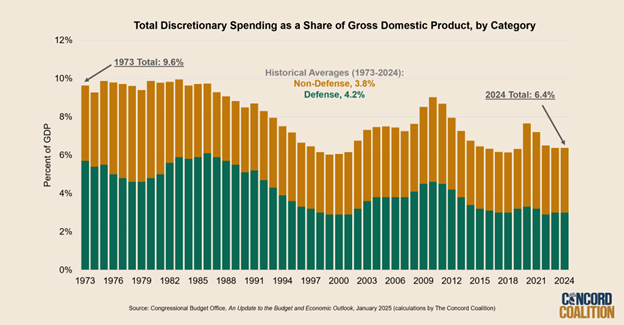
Defense spending was the largest federal spending category for much of the 20th century due to World War II, the Cold War, and other military conflicts abroad. After the collapse of the Soviet Union and the end of the Cold War, U.S. defense spending dropped to its lowest level in decades in 1999, 2.9 percent of gross domestic product (GDP). This decline, referred to as the “peace” dividend, resulted from a reduced need for defense spending, freeing up resources to be invested in other areas of the economy.
The peace dividend was short-lived. In the 2000s, Congress increased defense spending to fund conflicts in Afghanistan and Iraq. But by 2011, defense spending began to fall once again due to military drawdowns abroad and tight budget caps put in place by the 2011 Budget Control Act. Since 2020, defense spending has sunk to its lowest levels in modern history following the COVID-19 pandemic – sitting at 2.9 percent of GDP once again, less than non-defense discretionary spending.
Like the rest of the federal government, the Defense Department’s budget is strained by changing demographics and rising health care costs. The military’s largest expenses are for personnel compensation and benefits, and lawmakers have done little to overhaul the military’s health and pension systems. General financial reforms are needed at the Defense Department as well. The Pentagon has never passed a financial statement audit. Continued failure to properly manage and account for growing expenses and contracts risks crowding out other important investments in military readiness – and potentially jeopardizes national security.
Non-Defense Discretionary Spending
Non-defense discretionary spending includes a wide selection of programs, like funding for homeland security, transportation, disaster assistance and environmental programs, public housing, and domestic law enforcement. Non-defense discretionary spending also includes critical investments in our nation’s future such as infrastructure, education, and scientific research.
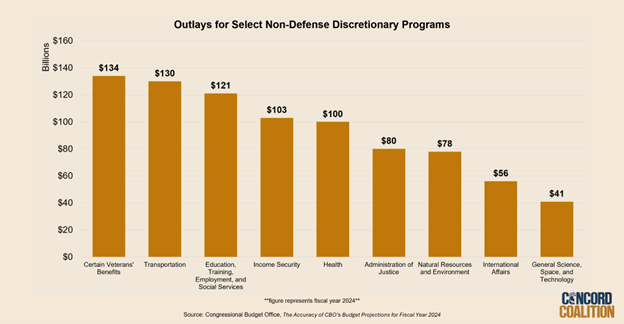
Many proposals to reduce the federal deficit purport to achieve significant savings through unspecified reductions in non-defense discretionary spending, often framed as cutting waste, fraud, and abuse. But the departments and programs that are included in this part of the budget have already been tightly constrained in recent years and are projected to continue declining relative to the size of the economy under current law. Substantial additional savings in this part of the budget will be increasingly difficult to achieve.
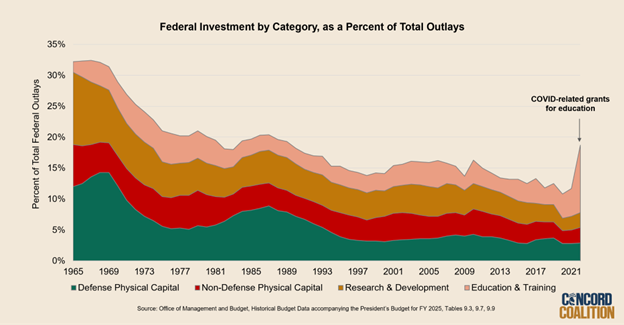
Lawmakers must be careful not to neglect important national priorities and legitimate investments in the country’s future in the name of cutting “waste.” Investments that contribute to a growing economy in infrastructure, research and development, and education have already been on the decline as a share of federal spending.
Recent Trends
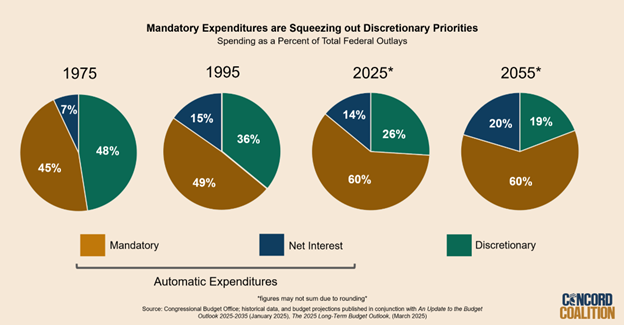
Prior to 1975, more than half of the federal budget consisted of discretionary spending. Lawmakers and the president had the ability to adjust most federal spending on an annual basis, giving them the fiscal flexibility to adapt to changing economic and geopolitical circumstances. Changing demographics, rising debt and interest rates, and the growth of mandatory spending, however, have resulted in an increasingly large portion of the federal budget operating on auto-pilot. Today only a quarter of federal spending is discretionary.
In the 2010s, Congress moved to address unsustainable deficits by placing separate caps on defense and non-defense discretionary spending. Designed to reduce projected discretionary spending, these caps were to be enforced with automatic, across-the-board spending cuts known as “sequestration.” Unfortunately, the caps were unrealistic and difficult to maintain, and sequestration as an enforcement mechanism sacrificed thoughtful policy choices about spending and investment priorities for automatic cuts. Congress also found ways to avoid adhering to these caps by changing them in bipartisan budget deals or exempting additional spending by designating it as an “emergency.”
More than that, no matter how deep discretionary spending cuts are, they are not a substitute for revenue and mandatory spending reforms. Deficits have grown so large that they exceeded the size of all discretionary spending in fiscal year 2024 and are projected to so in the future because of large tax cuts that weren’t paid for, rising mandatory spending and interest payments on the debt.
While some additional savings from discretionary spending can be part of fiscal reform efforts, those efforts must also tackle the real drivers of our long-term fiscal challenges: the growth in mandatory spending, rising interest payments on the debt, and whether we are collecting sufficient revenue to pay for the spending commitments we have made.
Continue Reading