Most Americans know that the defense budget constitutes a substantial portion of federal spending, but there remains plenty of confusion as to just how much. While a quick search can answer that for you (spoiler alert: $850 billion in FY 2024 according to the Congressional Budget Office), once you get beyond that simple figure, the waters become murky. How does that compare with the overall federal budget? What do we spend the money on? Is it growing, shrinking, or relatively flat? What role does it play in the fiscal outlook relative to other programs?
These are important questions because the defense budget is important for every voter and taxpayer to understand. So, let’s do our civic duty and go over some important defense budget questions.
What is the “defense budget”?
A common point of confusion regarding the phrase “defense budget” is the actual meaning of the term. Counterintuitively, it does not refer solely to the “Pentagon Budget” which covers just the conventional military spending under the Department of Defense (although this is the largest portion of the defense budget 1).
The term “defense budget” is the portion of the federal budget allocated to the National Defense budget function (numerically, function 050), and is the sum of three subfunctions:
Department of Defense – Military (budget function 051) consists of all spending on behalf of Department of Defense military activities, including military personnel salaries and benefits; procurement of weapons, ships, aircraft, and vehicles; construction of military bases, buildings, and housing; military research, development, testing, and evaluation; and operations and maintenance.
Atomic Energy Defense Activities (budget function 053) encompasses spending by the Department of Energy and other agencies for nuclear-related purposes, including the development of naval reactors and weapons activities.
Defense Related Activities (budget function 054) covers a narrow subset of activities in a small group of agencies that perform defense-related activities like the FBI, CIA, Coast Guard, FEMA, and the Department of Homeland Security.
Notably, the defense budget does not include:
Funding for veterans’ healthcare and benefits, which is covered under budget function 700. These numbers are significant too, with outlays totaling $326 billion in 2024.
Other activities that could plausibly be construed as related to defense, such as the majority of Coast Guard activities, are covered under the budget function Transportation (400), along with the Transportation Security Administration (TSA)
Many homeland security functions, such as border security, fall under Administration of Justice (750), and many diplomatic and alliance-related activities are covered under International Affairs (150).
How does the defense budget compare globally?
The U.S. defense budget is the world’s largest by far. The United States accounted for approximately 37% of global military expenditure in 2024, spending more than the next several countries combined. Compared to other Group of Seven (G7) countries–Canada, France, Germany, Italy, Japan, the United Kingdom, and the United States–the US spends 12.5% of its government spending on defense, while the rest of these countries spend an average of 3.71% of their national spending.
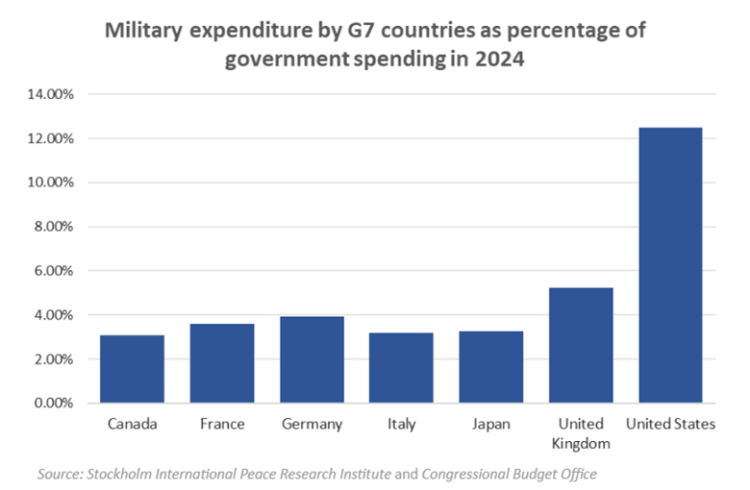 However, while it is important to see how the US compares globally, it can be misleading to think of the defense budget only in comparison to other countries. The U.S. has one of the largest economies in the world, so it can spend more in absolute terms without bearing the same economic burden as smaller countries. Looking beyond global comparisons, it also matters where defense spending falls within total federal spending.
How does defense fit within the overall federal budget?
One poll from AP News reports roughly one-third of American adults believe the federal government spends ‘too much’ on the military, another third think it receives ‘too little’ funding, and the remaining third say the military’s budget is ‘about right. This highlights the mixed understanding about the size and priority of defense spending among the general public.
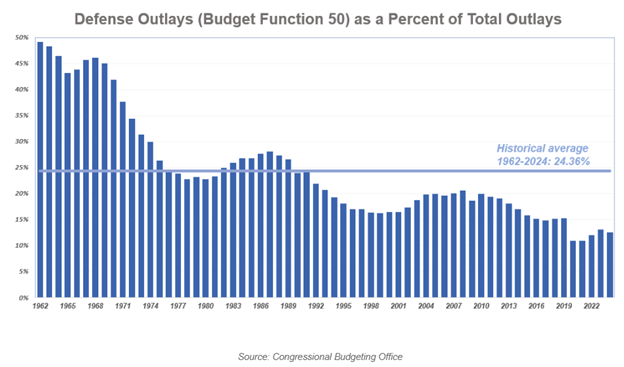 Data from 2024 shows that defense outlays made up just over 12.5% of total federal budget outlays that year, about half of the historical average of 24% federal spending. As expected, the pattern of higher defense spending as a share of the budget has aligned with major military conflicts: 1960s (the Vietnam war), the 1980s (the Cold War), and the 2000s (the war in Iraq).
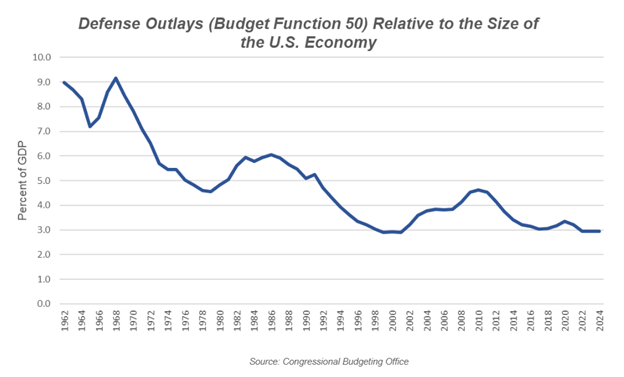
Measured as a share of the economy, defense spending was 2.9% of gross domestic product (GDP) in 2024, matching its lowest level since 1962. It is important to note that the United States is approaching record levels of national debt despite defense spending that is historically low as a share of the economy.
 Defense Spending is a Large Share of Discretionary Spending
Some of the confusion regarding the proportion of defense spending in the federal budget may stem from a failure to distinguish between total federal spending and discretionary spending. Discretionary spending is the portion of the budget controlled by the annual appropriations process, which now accounts for about one quarter of all outlays. So while the defense budget comprised only 12.5% of total federal spending in 2024, it also comprised 52% of all discretionary spending.
Framing defense spending as a share of discretionary spending can lead to misleading conclusions about how to fix the fiscal situation and shifts attention away from larger programs that contribute more heavily to long-term budget pressures. Understanding these distinctions is key for anyone trying to make sense of federal spending, because it shows that while defense is a major part of discretionary spending, it is far from the only driver of the federal budget or the nation’s long-term fiscal challenges.
Footnotes
1 Although most of Department of Defense spending is covered in National Defense (050) spending, under the subfunction Department of Defense – Military (051), some of it is spread among other budget functions. See this Congressional Research Service primer for more information on this and other National Defense (050) issues.
Continue Reading