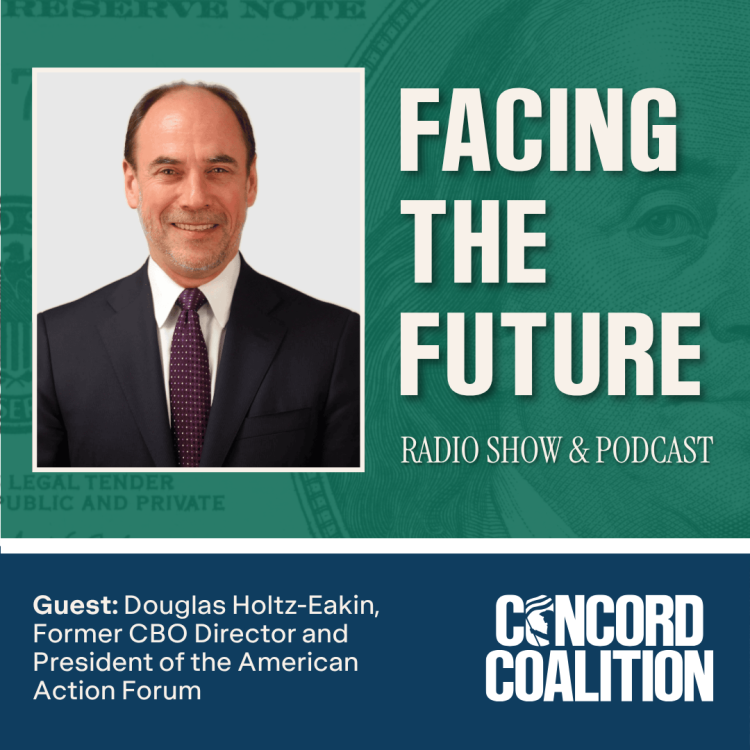
This week on Facing the Future, Douglas Holtz-Eakin of the American Action Forum and former director of the Congressional Budget Office discussed the economy, potential war costs and how the rapid growth of U.S. debt is already having a negative impact on the economy and living standards.
Holtz-Eakin was not surprised by the Federal Reserve Board’s decision to leave interest rates unchanged at the March meeting. He pointed out that there are conflicting pressures on the Fed with a surprising loss of jobs in February, providing support for a rate cut, while inflation remained above the Fed’s target rate, providing a reason not to cut.
“I don’t think they’re in a position where they’re going to raise rates,” he said, “so they stayed the same. That’s not shocking.”
The conflict in Iran, particularly how it has virtually halted passage through the Strait of Hormuz, complicates the economic outlook. “Conventional wisdom on monetary policy is, if you’re going to have a price spike, an oil shock, you look past it,” Holtz-Eakin said. “Costs are pushed up, and there are headwinds to growth, but you get good news in the future as it unwinds, because you get a reduction in costs and an impetus to growth. If it’s sustained, then the Fed really has a problem, because you’re going to get higher prices and without a doubt it’s bad for growth. If oil prices stay at $115, $120 per barrel for a couple of months we have problems.”
Moreover, war costs are taking a toll on the budget. Holtz-Eakin noted that the war cost $11 billion in the first 6 days. “So that’s basically $2 billion a day,” he said. “If you look back, the Iraq war costs were roughly $100 billion a year. We’re on a $700 billion pace [$2 billion x 365 days], so this is an enormously expensive war, and we probably have not yet factored in all the replacement costs for what are pretty pricey munitions they’re blowing up.”
Holtz-Eakin was the CBO director in 2003 when the U.S. invaded Iraq. He recalled that the promises from the Bush Administration were that “it would cost between $50 and $70 billion, it would last less than a year, and there was no reason to put it on the budget. We could just do it on the side. All of that turned out to be wrong. And so, how we handle this budgetarily, I think, is important.
“We are $40 trillion in the red,” he observed, “and have no real plan to deal with the fundamental imbalances between taxes and spending. So, I can’t say there’s any good news on the budgetary front from this.”
He outlined the mechanics of a debt-induced fiscal crisis: “You get an interest rate spike, the world starts charging you a lot more interest because you’re a less reliable debtor, and they want to get their money back quickly, and they want a lot of it in case you ultimately don’t fully repay. That spike starts a recession and the recession exacerbates the revenue problem to begin with, and the spike becomes even bigger, or you just get cut off entirely, and people stop lending to you. So now you have a genuine domestic and economic crisis unfolding and simultaneously, you can’t borrow anymore, at least internationally, and in a recession there’s going to be no great domestic lending.
“So you have to do some really, really, really bad news things in a recession,” he continued. “You have to raise taxes sharply and quickly, and you have to have draconian cuts in spending. Discretionary spending gets slashed, and taxes go up, and in the middle of a recession, that’s bad. So there’s no good news for the average American in that scenario. It’s just bad. And it takes a while. Historically, it takes 5-10 years to dig out of these things and get back into good standing with the credit markets and get the taxes back to a reasonable level.
“The wildcard,” he said “has always been, when does that crisis happen? And the answer is, I don’t know and I don’t want to find out. I see no good reason to run the experiment so that we know how long the world’s largest economic power, that is the reserve currency, can take advantage of its status and run big deficits. Let’s not find out. Let’s take care of business and get the house in order.”
In a political environment where affordability has become a defining issue, Holttz-Eakin said that “raising real wages, raising the standard of living, is how you deliver broad-based affordability. We’re doing a terrible job on that affordability front. In the 20th century, we took care of business. Deficits averaged 2.3% of GDP. That was a century and an era when people cared about fiscal policy and the deficit, and we balanced the budget at the end of that period. And guess what? We had good economic performance as well. Income per capita grew to an annual rate that was fast enough that the standard of living doubled every 29 years.
“In the 21st century, it’s a completely different story,” he said. “Deficits are now 5% of GDP on average and headed to 7%. The standard of living doesn’t grow as fast. We’ve had much poorer growth, a percentage point slower, and it takes 56 years now for the standard of living to double. So, there’s a palpable sense that young people today don’t have the same opportunities as their parents. That’s actually true, in my view, and I believe one of the reasons is business as usual. We spend $7 trillion, raise $5 in taxes, borrow $2 trillion and for 25 straight years in the 21st century, we have been doing something like that, and that means that $2 trillion is not available to businesses, to train workers, buy better equipment, do mergers and acquisitions. It’s not available to send people to colleges, it’s not available to do any of the things that raise their productivity, and thus their real wages and affordability. It’s a huge problem for us, and it happens every year. Any one year isn’t that big a deal, but cumulatively, to do that for two and a half decades, it’s turned into a big deal.”
Hear more on Facing the Future. Concord Coalition Senior Advisor Bob Bixby hosts the program each week on WKXL in Concord N.H., and it is also available via podcast. Join us as The Concord Coalition team discusses issues relating to national fiscal policy with budget experts, industry leaders, and elected officials. Past broadcasts are available here. You can subscribe to the podcast on Spotify, Pandora, iTunes, Google Podcasts, Stitcher, or with an RSS feed. Follow Facing the Future on Facebook, and watch videos from past episodes on The Concord Coalition YouTube channel.