Building Achievable Fiscal Policy: Insights from Former Lawmakers Rob Portman and Carolyn Bourdeaux
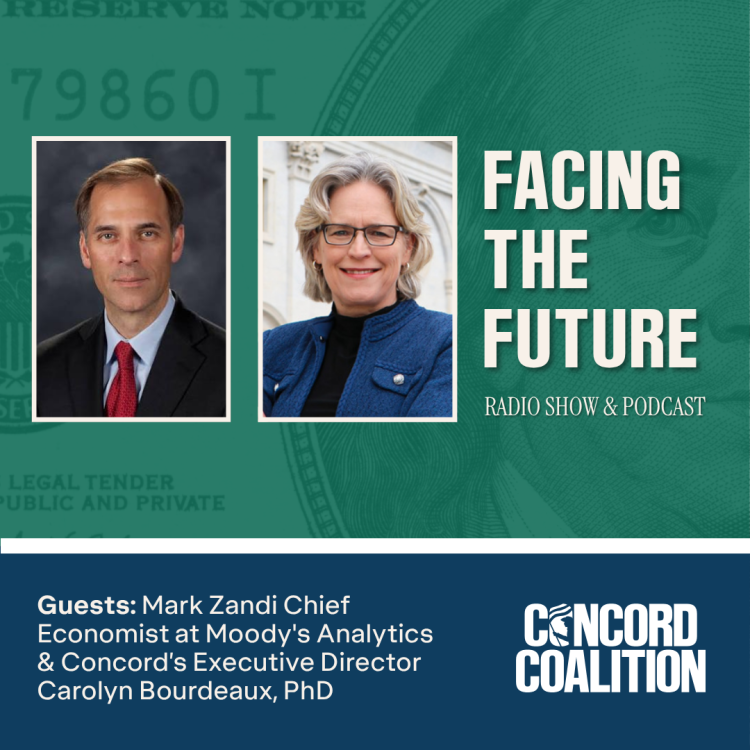
This week, Facing the Future features a recent panel discussion hosted by the University of Cincinnati’s Portman Center that brought together two former members of Congress, Senator Rob Portman and Representative Carolyn Bourdeaux. They explored America’s fiscal challenges and the potential pathways to a sustainable future. The conversation was moderated by Alex Brill, a senior fellow at the American Enterprise Institute.
Both panelists brought unique perspectives shaped by their time in public service. Bourdeaux, with extensive experience in state budgeting as Georgia’s Senate Budget Office director during the Great Recession, highlighted a stark contrast between state and federal fiscal discipline. “At the state level, the expectation to balance the budget is deeply ingrained,” she explained. “Legislators believe in their heart and soul that they have to balance the budget, and constituents expect it. The debate is not whether to balance it, but how to do it fairly.” She contrasted this with the federal level, where “that sense of trade-off, that expectation is just not there.”
Portman echoed the importance of process and discipline, drawing from his experience as Office of Management and Budget director under President George W. Bush when attempting to craft a five-year balanced budget. “Having that discipline of saying you’ve got to balance the budget, which you do in your lives every day… that’s just the way life is everywhere except in the United States Congress,” he said. Portman acknowledged the difficulty of embedding such discipline into federal law, noting, “it would require a constitutional amendment… and that’s very difficult to get.”
The panelists also discussed the role of mandatory spending, such as Social Security and Medicare, which currently runs on “autopilot” and together with interest on the debt consumes approximately 75% of the federal budget. Bourdeaux emphasized that unlike the federal government, states like Georgia include mandatory programs such as Medicaid in their annual budget decisions, forcing trade-offs with other priorities. This dynamic fosters fiscal responsibility and transparency that is often lacking at the national level.
One of the most promising ideas discussed was the establishment of an independent bipartisan fiscal commission, modeled on past efforts like the Simpson-Bowles Commission and the Base Realignment and Closure (BRAC) process. Portman advocated for such a commission, noting that “it should include members of Congress, House and Senate, also some outside experts,” with the goal of providing recommendations subject to an up-or-down vote. “It has been done before successfully,” he reminded the audience, though he acknowledged the political challenges involved.
Bourdeaux agreed but suggested that the commission’s recommendations should be exempt from Senate filibuster rules to ease enactment. She also highlighted the importance of public education, stating, “The first year should be all about education,” helping both lawmakers and citizens understand the breadth and urgency of the fiscal challenges.
The conversation further addressed the delicate balance between urgency and thoughtful legislation, especially in the context of executive action and Senate voting thresholds. Portman cautioned against dismantling institutional safeguards like the filibuster despite the pressing nature of the fiscal crisis, arguing that “we need to be urgent in terms of our appeal to people and get people invested in this,” but also careful to “make sure it fits with our long-term interest as a country.”
On tax policy, Brill noted the evolving positions within both parties and asked whether this shift could open doors for bipartisan cooperation. Bourdeaux observed a potential political realignment, saying, “Maybe in that there is some kind of opportunity to try to solve the problems around the revenue situation,” while Portman highlighted that “there is no way politically that this moves forward without that trade-off” between spending cuts and revenue increases.
The panelists also spoke candidly about the importance of restoring public trust by aggressively addressing waste, fraud, and abuse in government programs. Bourdeaux remarked, “There does have to be a re-establishment of trust, that this is an efficient government. We’ve thought very, very carefully about every taxpayer dollar you give us,” acknowledging that while some waste is inevitable, it must be minimized for the public to support fiscal reforms.
Finally, the discussion touched on how fiscal policy affects demographics and family decisions, with Portman noting that policies encouraging family formation and child-rearing—such as reducing marriage penalties in the tax code or easing childcare costs—could positively influence the fiscal outlook. He warned, however, that uncertainty about the future might discourage young people from starting families, which in turn exacerbates population aging and contributes to the long-term fiscal challenges .
In summary, the panel underscored that while America’s fiscal challenges are daunting, bipartisan solutions grounded in discipline, transparency, and education are achievable. As Bourdeaux put it, “We need to start somewhere. We need to start getting ideas out on the table,” while Portman emphasized that “process matters” and that “having that discipline” is key to turning the tide.
The conversation offered a hopeful yet realistic path forward—one that demands political will, public engagement, and a commitment to balanced budgeting that reflects the nation’s values and economic realities.