The official federal budget process was established in 1974 by the Congressional Budget and Impoundment Control Act. The budget process begins in February, when the president is supposed to submit his plan to Congress after discussions with federal department and agency leaders about their needs. The president’s budget is simply a recommendation to the legislative branch, which under the Constitution has the “power of the purse” to make decisions about funding.
After the president has submitted his budget, the first step for Congress is to draft and adopt a concurrent budget resolution. Because budgets are concurrent resolutions rather than joint resolutions, they do not require the president’s signature – only a majority vote in both chambers of Congress. The budget resolution includes instructions that guide Congress in spending and taxing decisions throughout the year. The resolution establishes how much revenue needs to be raised and how much should be spent overall, but leaves it up to congressional committees to determine how those targets will be met.
The next step is for Congress to enact 12 appropriations bills that fund “discretionary” spending programs for the coming fiscal year. These spending bills include funding for both national defense and for domestic areas such as law enforcement, the judicial system, the environment, education, medical research and transportation. The House of Representatives and Senate can begin considering these bills after April 15.
In recent years, however, the budget process has repeatedly broken down and lawmakers have failed to pass a budget resolution on time – if they pass one at all. In these instances, Congress often appropriates without operating under a budget resolution. Unlike the budget resolution, the 12 appropriations bills need the president’s signature to take effect.
If Congress fails to pass all 12 appropriations bills by Oct. 1, which marks the beginning of the next fiscal year, lawmakers have two options: allow a partial government shutdown, or pass a “continuing resolution,” which generally continues to fund discretionary programs at the previous year’s levels for a certain period of time. The most frequent pattern is for Congress to pass a continuing resolution. The most recent government shutdown occurred in 2013 and lasted for 16 days.
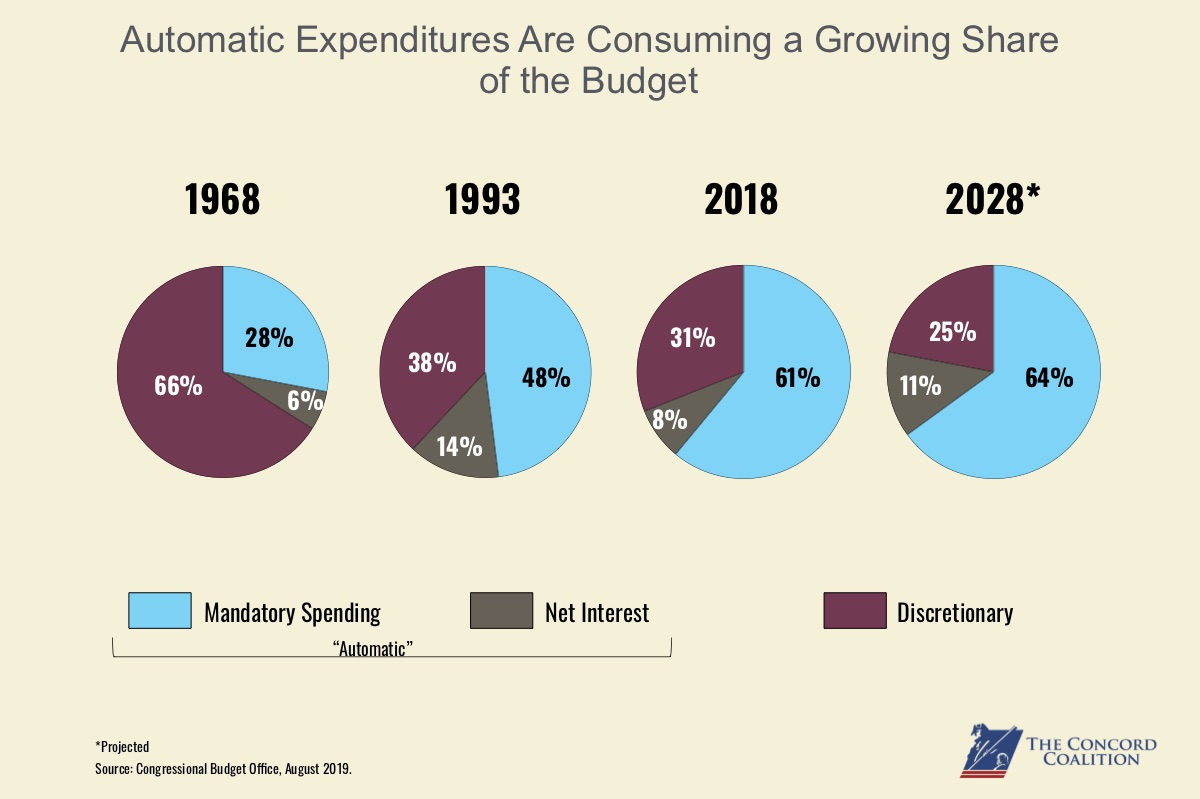
Despite taking up the lion’s share of the budget process, discretionary spending actually comprises less than one third of the federal budget. Taxes and spending on entitlement programs like Social Security and Medicare are known as “mandatory spending.” Spending for these programs is set by formulas which can only be changed by new law. If no action is taken, these programs continue operating on autopilot.
Changes to taxes and spending, including entitlement programs (with the exception of Social Security), can be fast-tracked through an important legislative vehicle known as “reconciliation.” The reconciliation process is an optional procedure that was intended to allow Congress to consider deficit reduction legislation that brings overall tax and spending levels in line with the budget resolution. It is particularly important in the Senate, where reconciliation bills cannot be filibustered and are protected by points of order that restrict the amendments that can be offered. Reconciliation is only available when a concurrent budget resolution has been adopted.
If policymakers wish to increase mandatory spending or decrease revenues, such changes are subject to statutory pay-as-you-go rules, also known as PAYGO. These rules require lawmakers to offset most deficit-increasing legislation over the following five and 10 fiscal years.
Unfortunately, not since the inception of the budget process have lawmakers passed a budget resolution and all appropriations bills on time in a given year. In fact, the growing trend is for nothing to pass on time. Given the frequency with which the budget process breaks down, many options for reform have been proposed. One promising idea is biennial budgeting, which would create a two-year budget cycle in which the second year could focus more on oversight and long-term planning. Other ideas for reform have centered around finding new ways to subject taxes and mandatory spending to more frequent scrutiny than at present.
Ultimately, however, a budget process is only as useful as the willingness of policymakers to adhere to it. Several commissions have been established over the years to circumvent regular order and propose sustainable fiscal policies that could appeal to both parties, yet lawmakers have consistently declined to embrace their proposals. These experiences demonstrate that if elected officials lack the political will to make hard choices and political tradeoffs, no amount of process reform can substitute for it.
Continue Reading