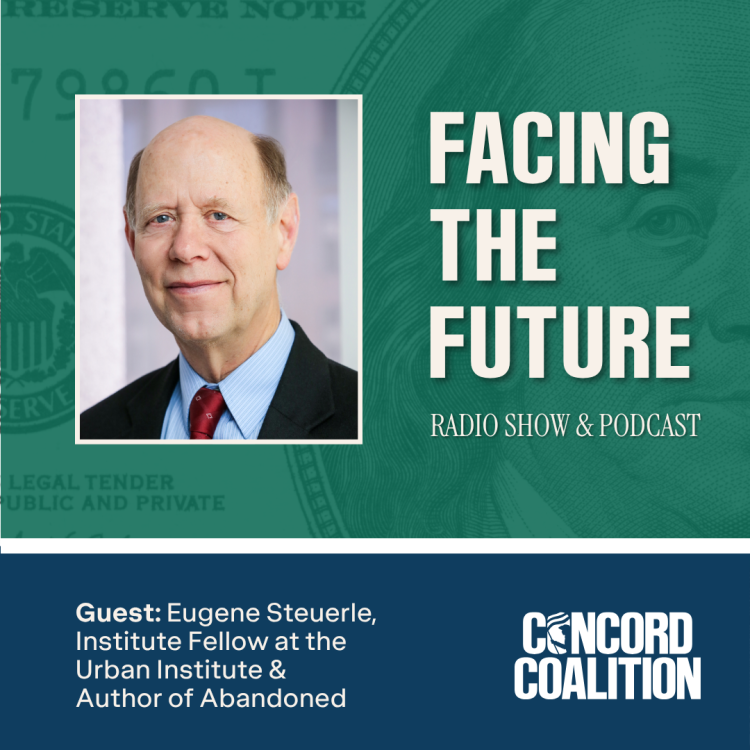
This week on Facing the Future, Peter Fisher, Distinguished Senior Fellow at the MIT Golub Center for Finance and Policy, described the potential consequences of America’s “untethered fiscal policy” and the risk of hyperinflation and default. Concord Coalition Executive Director Carolyn Bourdeaux joined the conversation.
“The debt we have and the deficits we have aren’t as frightening as the projection that they just get ever larger,” Fisher said. “Debt to GDP is high, it’s way over 100 percent now, and headed higher. It’s not really the quantum of it that should disturb us, it’s the path forward.”
Fisher also warned, “There’s no relationship between the revenues this federal government collects and the spending it doles out. And that’s what should frighten us.”
He elaborated on the connection between politics and fiscal policy. “I don’t think we can expect our fiscal policy, which comes from Congress, to be tethered, to be coherent, if our politics are not coherent. The two parties don’t really talk to each other. They talk past each other. So, I try to draw a line between our untethered fiscal position and our untethered politics. We shouldn’t knock our heads against a wall wondering why we have a bad fiscal outlook, because it comes from Congress. Congress has the power and the responsibility to give us a sensible path of spending and taxes, and they are not doing it,” he said.
Fisher described “reciprocal false premises” that Republicans and Democrats rely on. “One party,” he said “thinks that we can find our way to balance by cutting spending even as they lower taxes. We won’t get to balance that way. That’s just baloney. It’s not gonna work. The other party thinks we can keep raising taxes, even while we increase spending, without broadening the tax base, without extending to more people, and that’s untenable, too. The path to political will being found is when each party acknowledges that their idea isn’t going to work. Then they can do it with each other and find some other path. But they won’t find the other path to try to achieve balance, until they admit that their rhetoric won’t get us there.”
In the absence of a legislative course correction Fisher said, ”The most likely outcome is that eventually you get rising inflation, because the spending of the federal government keeps apace and that’s a stimulant to the economy, and we keep borrowing, and then you approach problems of hyperinflation. That’s the path you can see in other countries, where the government just keeps borrowing, keeps borrowing, keeps spending. I have a lot of faith in the Federal Reserve, but eventually they get overwhelmed.”
If the market were to lose confidence in the Fed’s independent judgement on how to balance the long-run growth of the economy, inflation, and the stability of the financial system, Fisher warned that it would “accelerate the moment of hyperinflation.”
He dismissed various ideas that have been floated for mitigating the negative economic effects of the debt, such as the Fed buying more government bonds or the Treasury selectively defaulting on a portion of the debt.
“If inflation is very low,” he said, ”as it was in the 2008-2009 period, and we were worried about deflation then the Federal Reserve can buy a lot of bonds and issue a lot of money because we’re not worried about inflation. It’s quite different if we have rising inflation, in which case, buying all those bonds is a form of easing monetary policy, and will stimulate more inflation. That might work in really unfortunate conditions of deflation but it’s not going to work if inflation is where it is now, or rising, because it’ll just make things worse. It won’t lower interest rates for the Fed to be buying the debt and printing the money. It will be increasing interest rates, not what the doctor orders at that moment.”
As for selective default, Fisher, a former Under Secretary of the U.S. Treasury for Domestic Finance said, “That’s a foolish path to go down.” He explained, “If you become known to be a liar, that you don’t keep your promises, how do people know whether to trust you next time?
I just don’t think we can say, ‘I’m going to choose the people I don’t like, and I’m going to break my promises to them, I’m not going to pay them back, and I’m going to pay back the people I like.’ Well, how does anyone think you’re credible tomorrow, or the day after? So, I think that’s just a fantasy. That’s not how financial markets work.”
He added that if a default scenario were to play out, the U.S. would “have to pay a premium [for added risk], the dollar would probably weaken, and interest rates would go up, and we’d find ourselves not as well off as we thought we were. Our financial system would be struggling.”
Fisher believes that Congress must do the heavy lifting to get the nation back on a sustainable fiscal path. “We’ve lost the thread of how our fiscal policy is supposed to work,” he said. It’s supposed to come from Congress on all three levers [spending, revenue and borrowing] and they just have to take responsibility, so I don’t think there is another way other than Congress stepping up.”
If fiscal policy is not “tethered” anytime soon, Fisher says the Fed will have to mitigate the damages as best they can for as long as they can. “I think they can be up to it.” he said. “The question of personnel, and whether the president is going to change a number of governors soon and replace Chairman Powell with someone else in the new year, will have a profound impact on whether the Fed can navigate what would be difficult anyway, given where our economy is, as inflation is still a little too high, and the labor market is a little too soft. So, I think the Fed can be up to it, but if you change the personnel enough, then that would change my assessment.”
Hear more on Facing the Future. Concord Coalition Senior Advisor Bob Bixby hosts the program each week on WKXL in Concord N.H., and it is also available via podcast. Join us as The Concord Coalition team discusses issues relating to national fiscal policy with budget experts, industry leaders, and elected officials. Past broadcasts are available here. You can subscribe to the podcast on Spotify, Pandora, iTunes, Google Podcasts, Stitcher, or with an RSS feed. Follow Facing the Future on Facebook, and watch videos from past episodes on The Concord Coalition YouTube channel.