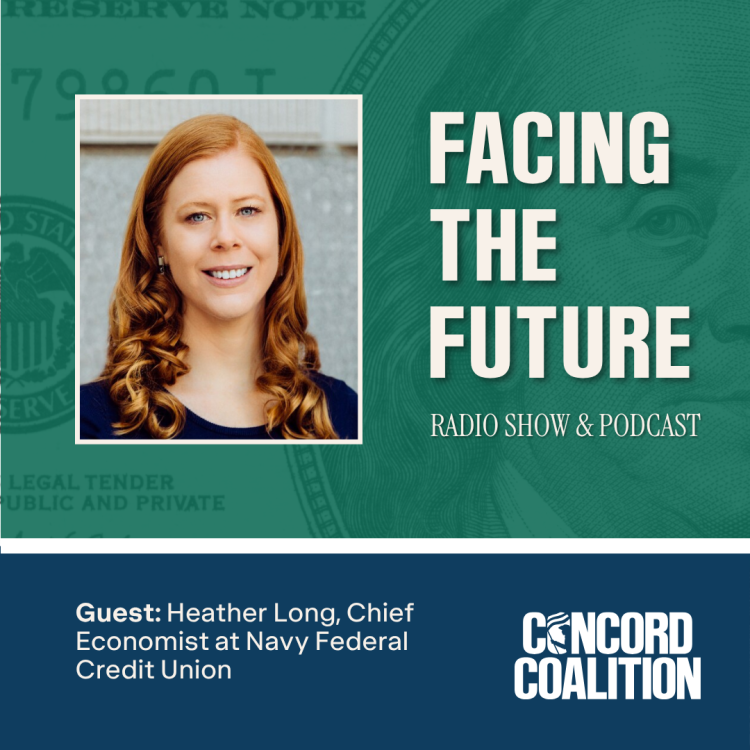
This week on Facing the Future, Heather Long, chief economist at Navy Federal Credit Union, discussed the economic risks of historically large federal budget deficits becoming the “new normal,” and why she believes that the growing U.S. debt means “the bond market is king.”
“We are in a new normal,” Long said, “because for the entire U.S. history prior to, let’s say 2020, we would have a war, like World War II, and we would spend a lot but then we would get back on track. And this happened over and over again, even after 9-11, or even after the Great Recession. We would find a way to improve and get back on track generally speaking, not perfect, but in a better position financially. And that just seems to be totally out the window.”
She noted that federal budget deficits now reach or exceed 6 percent of the gross domestic product (GDP) on a routine basis and are projected to do so indefinitely into the future. That is considerably higher than the 3.8 percent of GDP average deficit over the past 50 years.
Moreover, Long noted, “Starting in fiscal year 2024, we now spend more on interest payments than we do on defense. So this is starting to actually eat into our ability to fund the military or to fund education. Pick your favorite important program and the dollars are constricted because so much money is now going to interest payments.”
The fundamental shift toward chronically high deficits and rising debt means “the bond market is the new king,” Long said. “We saw a preview of this in the spring after the ‘Liberation Day’ tariffs. Whatever you think of tariffs, the bond market reacted and it was a freak-out. The 30-year Treasury topped 5 percent and the 10-year Treasury yield, which feeds into mortgage rates, got to 4.6 percent. That was a moment when the bond market spoke and the White House was forced to cave. News articles were talking about the ‘Sell America’ trade. This was a wake-up call.”
“The good news,” Long continued,”is that it didn’t turn out to be the tipping point, but I do think it was an early warning. Part of the reason the United States is ending 2025 not in that crisis scenario is the fact that our friends in Europe are much weaker than we are. Bond investors still don’t want to be in many countries in Europe, and are still punishing a lot of European nations, among other countries in the world, and so there has been a little bit of a flocking back to United States debt. But what really struck me was how quickly the narrative can shift on a country.”
Long believes, however, that “anybody who tells you the dollar is over is exaggerating hugely. The dollar’s not going up in flames, it’s not going to lose its reserve currency status anytime soon.” Instead, she described a “rebalancing” taking place. Investors are “not pulling everything out of the dollar, but they don’t want to be as fully in it as they were before. They’re doing a lot of hedging that they weren’t doing a couple of years ago when everything was coming up roses. And you can see central banks around the world are doing the same. They’re not selling all their dollar assets, but they’re transitioning some dollars into gold, some dollars into euros or yen. They’re moving on the margins. That’s a very different environment than where we were for the past 15 years.”
From her work at Navy Federal, Long sees how upward pressure on Treasury interest rates has a big effect on America’s household budgets. “Every day,” she said, “people call in and ask us what the latest auto loan and mortgage rates are and the reality is, if we have a debt crisis, the numbers we were talking about last spring are going to seem quaint. In the spring of 2025, the mortgage rates hit almost 7 percent. Nobody was buying a home. Same thing with autos, some of the weakest months we’ve seen in years for auto buying. If we have a debt crisis, that immediately filters through the economy, and that immediately makes it so much more expensive and difficult to start a business, to buy a home, to get an auto loan.”
Looking ahead, Long warned about the pending insolvency of the Social Security trust funds. “That doesn’t mean you get no money,” she said. “But they’ll have to start sending out smaller checks than people were used to. And that’s when it really hits millions of American families right in the gut. So if we don’t have a bond market, freak-out again before then, I think that will be the moment of reckoning, and it’ll be hard, and ugly, and tough, and a lot of people could potentially really lose out financially.”
Hear more on Facing the Future. Concord Coalition Senior Advisor Bob Bixby hosts the program each week on WKXL in Concord N.H., and it is also available via podcast. Join us as The Concord Coalition team discusses issues relating to national fiscal policy with budget experts, industry leaders, and elected officials. Past broadcasts are available here. You can subscribe to the podcast on Spotify, Pandora, iTunes, Google Podcasts, Stitcher, or with an RSS feed. Follow Facing the Future on Facebook, and watch videos from past episodes on The Concord Coalition YouTube channel.