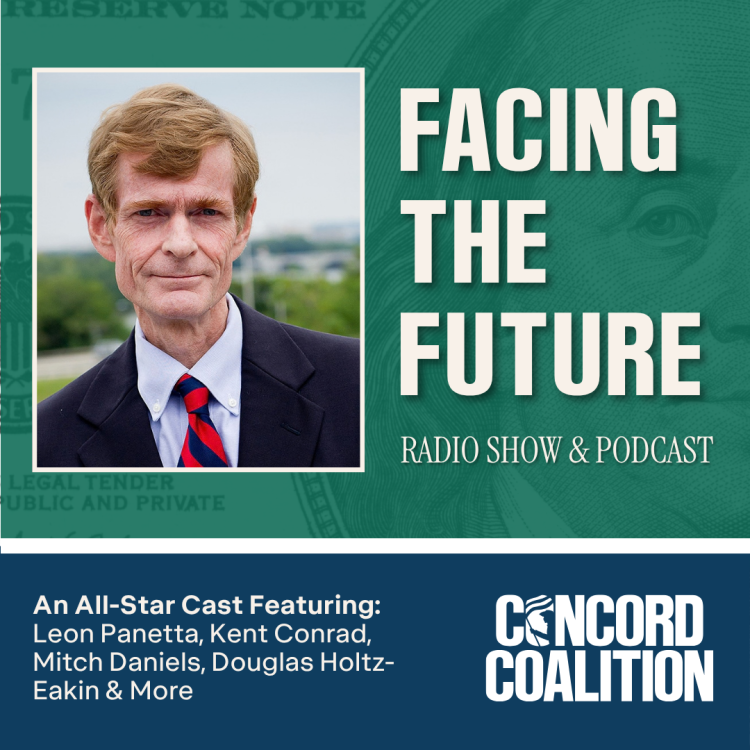
This week on Facing the Future, former Senator Kent Conrad (D-ND) discussed the breakdown of the federal budget process, the urgency of dealing with the nation’s unsustainable debt and the potential for a bipartisan fiscal commission to find solutions.
With none of the Fiscal Year 2026 appropriation bills finished, and only a few days remaining before a possible government shutdown, Conrad was critical of the lack of action. “I don’t know how my colleagues can think they’re doing their jobs when they don’t produce a budget for the United States of America. That is just not acceptable,” he commented.
“When [former Senator from New Hampshire] Judd Gregg and I ran the Budget Committee, I was the lead Democrat, he was the lead Republican, we had a couple of rules that we abided by. One was, at the end of the day we’re going to produce a budget, and we’re not going to play every game in the book in order to prevent that from happening. We would debate vigorously, we would have our disagreements, we would vote on amendments to change whatever package had been produced by whoever was chairman at the time. But at the end of the day, we would produce a result.”
Conrad was also critical of using the reconciliation process for advancing legislation that adds to the debt. He suggested a return to the Conrad Rule, named for him when he was chairman of the Senate Budget Committee. Under this rule, he explained, “You could not use reconciliation to add to the debt. The only reason reconciliation was created was to reduce deficits and debt. Now instead, reconciliation, this special fast-track procedure, is used to increase deficits and debt.”
Conrad said that he instituted the rule “because I was trying to keep faith with what my colleagues had done in the past who created reconciliation for the express purpose of reducing deficits and debt. It’s so wildly irresponsible to be doing what’s been done here. We have $37 trillion of debt, 123 percent of our gross domestic product, and they are using a special fast-track procedure to avoid the usual rules of the Senate in order to pass legislation to increase even further the deficits and debt of the country. It stands logic on its head.”
Conrad is not just concerned with the breakdown of the budget process. He is also concerned with the rising debt. “It’s very important,” he said, “for people to understand why debt and deficits make a difference. Over time, when you run up debt, you reduce societal savings. When you reduce societal savings, you reduce money that’s available for investment. When you reduce investment, you reduce economic growth. When you reduce economic growth, you reduce people’s opportunities to better their own economic lives. So all of these things are connected.”
Moreover, he noted that today’s sharply rising debt is coming when Social Security and Medicare are on the brink of insolvency. “We know from the trustees that Social Security is headed for insolvency in 2032,” he noted. “That’s just 7 years away. What happens when Social Security is insolvent? The law provides that at that point everyone getting Social Security will take a 24 percent cut. That’s what happens. These are the facts. We have to sober up in this country and understand there are real consequences with a failure to deal with this debt.”
Conrad believes that a bipartisan fiscal commission would help break the gridlock, if it is focused on finding solutions. “I entirely agree with those who say we’ve studied this enough,” he said. “This isn’t a study group. This is a commission to come up with specific recommendations that involve both the spending and the revenue side of the equation. So this is a commission designed to come up with a solution, not to study, that then is guaranteed a vote in the House and the Senate.”
“Now, this would be a very unpopular vote,” he conceded, “because you’ve got to have more revenue, you’ve got to have less spending. It’s a mathematical certainty that that’s what’s required when you’re running these massive debts. You’ve got to deal with both sides of the equation, both spending and with revenue. And I can tell you, spending programs in the United States are popular. Having tax cuts is popular. Doing something that would affect spending and affect revenue, in a way to reduce debt is not particularly popular, but one unpopular vote could get us back on track. We’ve done it before. We did it with Social Security back in the days of Tip O’Neill and Bob Dole. They saved Social Security. It can be done again. And the longer we wait, the more draconian the solutions will have to be.”
Hear more on Facing the Future. Concord Coalition Senior Advisor Bob Bixby hosts the program each week on WKXL in Concord N.H., and it is also available via podcast. Join us as The Concord Coalition team discusses issues relating to national fiscal policy with budget experts, industry leaders, and elected officials. Past broadcasts are available here. You can subscribe to the podcast on Spotify, Pandora, iTunes, Google Podcasts, Stitcher, or with an RSS feed. Follow Facing the Future on Facebook, and watch videos from past episodes on The Concord Coalition YouTube channel.