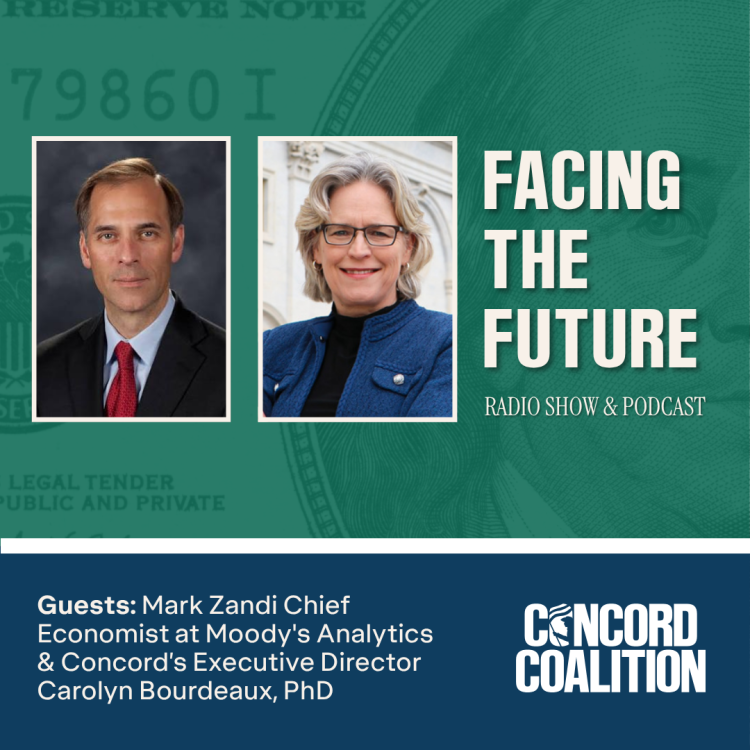
This week on Facing the Future, Mark Zandi, chief economist of Moody’s Analytics, explained why he believes the U. S. economy is edging closer to a recession. He also weighed-in on the dangers of runaway debt. Concord Coalition Executive Director Carolyn Bourdeaux joined the conversation.
“We got what I would call an economic data dump last week,” Zandi said, “and they were all uniformly bad to ugly.” He cited the latest numbers on economic growth, consumer spending, job growth, labor force growth and inflation. “All of them point to an economy that’s not in recession, but it feels pretty darn close and the direction is pretty disconcerting.” That assessment led him to conclude that the economy is “at the precipice of recession.”
Two factors Zandi cited are high tariffs and restrictive immigration policies. “They’re both showing up in the data,” he said. “The most recent labor force data for the foreign-born is actually declining. That has big impacts on industries that are dependent on those immigrants. Construction, manufacturing, agriculture, leisure, hospitality, retailing healthcare, personal services like childcare and elder care, health care to some degree are all impacted.”
“On the tariff front,” he continued, “you can see that in the data, too, both in terms of jobs and growth. But you can also see it in terms of prices. Tariffs are an effective tax, and that tax is levied through higher prices on consumers and business people. And you can see that in the inflation data. Those price increases were in the goods that are imported into the country and face those higher tariffs. So you can clearly connect the dots between these policies, immigration and trade tariffs, back to what’s happening in the economy.”
A positive element of higher tariffs is that they have been bringing in needed revenue. For context, however, Zandi compared the potential annualized tariff income of almost $300 billion to the current annual deficits of around $2 trillion. “It doesn’t solve the problem in any respect, but it’s moving in the right direction.” However, he cautioned that since the tariffs had been set by the executive, they were likely to change over time. “I certainly wouldn’t plan on having that revenue there when I’m making other spending and tax decisions. In fact, if you did do that, you’re setting yourselves up for even a more dire, darker, fiscal situation down the road, because I just don’t think those tariffs are going to be around 10 years from now, at least not where they are today.”
Zandi defended the Bureau of Labor Statistics (BLS) following President Trump’s decision to fire the BLS Commissioner when the July jobs report showed that job growth was slow in July and had been much slower than first estimated for May and June. “I work with the BLS and other government statistical agencies,” Zandi said, “and they have a long tradition of nonpartisanship. They assiduously work to preserve that. These folks are highly professional.”
“It does make me nervous when you start firing folks for the data.” he said. “The data is the data.” He explained that there is a risk to the economy from taking actions that cast doubt on the official numbers produced by the government.
“If people do lose faith that the data is of the highest quality, that’s going to cost the economy dearly in the long run,” he warned. For example, the BLS calculates the Consumer Price Index (CPI). “If the inflation data is suspect or just uncertain, you’re going to ask for a higher interest rate to compensate for that uncertainty. That’s the risk premium. It goes into the term premium of interest rates. So we are all going to be paying a higher interest rate, higher mortgage rates. The Treasury is going to be paying more on the debt. The cost to taxpayers is greater because we don’t have good quality CPI data. That’s just very clear.”
Another economic factor that concerns Zandi is the rapidly rising debt, which he described as “a big problem.” As the U.S. Treasury is faced with the need to finance an unsustainable level of debt, Zandi warned of an eventual bond market sell-off. “I think the odds of that are high and rising,” he said. “It’s not my baseline forecast because I just don’t know when it’s going to happen, but I do feel like that’s a real risk going forward.”
He elaborated with a metaphor: “All these things I just talked about is water building behind a dam. And if you’re looking at the dam from the other side, you’re going, “Okay, what’s the problem? But all of a sudden you see the problem, and that’s what triggers the water going over the dam or breaching the dam.”
In that scenario Zandi said, “The thing that we’d all feel is higher inflation and higher interest rates. It doesn’t necessarily mean a cliff event. It may be that we go into a recession, deep recession. But it does mean it’s a really heavy corrosive on the economy and on our standard of living and our well-being and our wealth and our long-term economic prospects.”
Hear more on Facing the Future. Concord Coalition Senior Advisor Bob Bixby hosts the program each week on WKXL in Concord N.H., and it is also available via podcast. Join us as The Concord Coalition team discusses issues relating to national fiscal policy with budget experts, industry leaders, and elected officials. Past broadcasts are available here. You can subscribe to the podcast on Spotify, Pandora, iTunes, Google Podcasts, Stitcher, or with an RSS feed. Follow Facing the Future on Facebook, and watch videos from past episodes on The Concord Coalition YouTube channel.