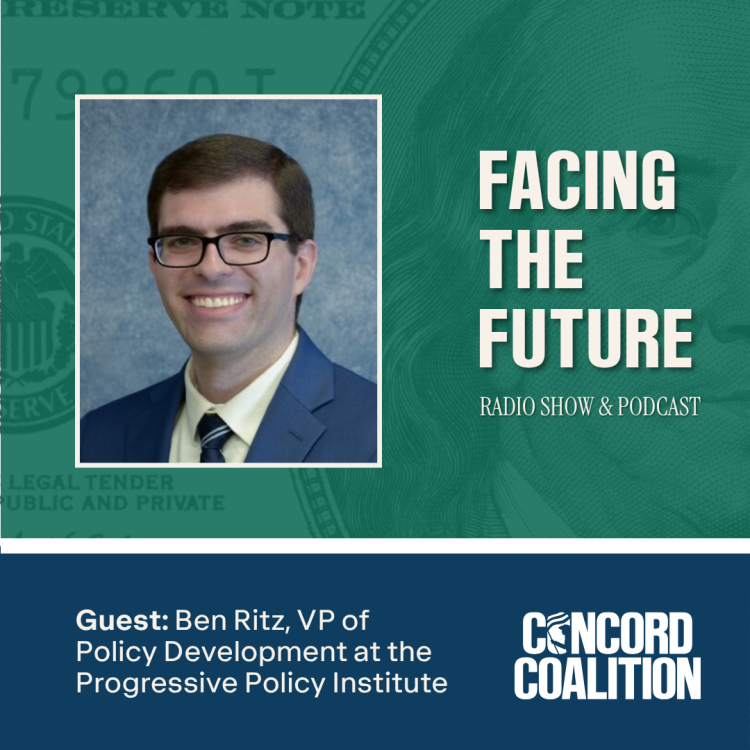
This week on Facing the Future, we looked at the daunting agenda facing Congress as it gets back to work following a 43-day government shutdown. The guest was Ben Ritz, Vice President of Policy Development at the Progressive Policy Institute, which describes itself as “radically pragmatic.” Ritz shared his perspectives on reforming Affordable Care Act (ACA) subsidies, shutdown politics and Social Security reform.
As part of the agreement to end the shutdown, Senate Majority Leader John Thune (R-SD) agreed to allow a vote on a bill of the Democrats’ choosing to deal with the enhanced ACA premium subsidies scheduled to expire at the the end of the year.
According to Ritz, “The big question facing Democrats is are they going to put up a bill that just extends the expanded credits that were enacted during the COVID pandemic and extended in the Inflation Reduction Act, or are they going to do something that has some reforms baked in? If Democrats throw something like a 3-year extension on the floor, we know that’s going to fail. Republicans are not going to support it.”
Ritz urged a different approach. Democrats, he said, “have an opportunity to push for something that includes some structural reforms that make this a more durable long-term policy as opposed to what I think was the maybe overly generous policy enacted during the pandemic that made sense during the pandemic, but doesn’t really make sense as long-term policy. If they put something up there that is a more pragmatic, long-term, focused reform, that will make it harder for Republicans to just dismiss it out of hand.”
Ritz argued, however, that the enhanced subsidies should not be allowed to fully expire because that would restore a problematic benefit cliff. He explained, “It used to be that at 400 percent of the federal poverty level people would immediately lose any support. You earn a dollar over the threshold and suddenly you’re losing thousands of dollars in tax credits. Healthcare’s no longer affordable. That’s a huge work disincentive. It’s not a fair policy. It’s very costly for individuals. It’s bad for the healthcare system. And so I think the top priority needs to be making sure that that cliff doesn’t come back, and then related to that, keeping premiums affordable while also making it affordable for taxpayers, too.”
Instead of reinstating the benefit cliff, Ritz recommends gradually phasing out subsidies for households as income goes up. Households below 300 percent of the poverty level would be allowed to keep the more generous subsidies first enacted during the pandemic.
“We propose that it be paid for,” Ritz said, “with two policy reforms, primarily using Medicare to get costs down. The first is the No Up Code Act, to prevent Medicare Advantage insurers from trying to find artificial ways to increase the subsidy they get for each person they take on. And then the other policy we propose is site-neutral payment reform. Medicare often pays a higher rate for services that are performed in a hospital setting than if the same service is performed at an independent physician office. Not only does that lead to us wasting a lot of money on paying more for the same procedure done in a different setting, but it also encourages consolidation, because for independent physicians, if they get acquired by a hospital system, then suddenly they’re eligible for higher reimbursement rate even if they’re not really changing anything about their practice. Together, that package gives you something that allows us to extend the ACA tax credit in some form for a longer term, permanently gets rid of the benefit cliff, and fully pays for it with policies that actually bend the healthcare cost curve, rather than simply moving the cost of it onto taxpayers.”
Ritz also described his Social Security reform proposal. “At the core of our proposal,” he said, ”is this idea that instead of awarding benefits based on how much somebody earns, we should award benefits based on how much they work. Right now, Social Security gives higher benefits to people who have higher lifetime earnings because the designers of Social Security wanted it to be an earned benefit based on how much you pay in. The more you pay in, the more you get out. The problem is that the current generation of retirees did not pay in enough to cover their benefits and so the trust funds are going to run out. That exhaustion is going to be in 2032, before the end of the next president’s term and so we have to do something about that.”
“Look, there’s no one silver bullet for Social Security anymore,” Ritz said. “It’s going to take a package of reforms. Our plan overall would fix the program roughly half through benefits changes and half through tax increases. Importantly, we propose a big revenue change. The payroll tax heavily undermines the progressivity of the income tax. It’s an anti-work tax and it places the burden exclusively on working Americans. What we propose is to move towards a consumption tax, which spreads the burden of financing Social Security. And because it’s a tax on consumption, it encourages savings and investment, and is more pro-growth and is a more efficient revenue source.”
Hear more on Facing the Future. Concord Coalition Senior Advisor Bob Bixby hosts the program each week on WKXL in Concord N.H., and it is also available via podcast. Join us as The Concord Coalition team discusses issues relating to national fiscal policy with budget experts, industry leaders, and elected officials. Past broadcasts are available here. You can subscribe to the podcast on Spotify, Pandora, iTunes, Google Podcasts, Stitcher, or with an RSS feed. Follow Facing the Future on Facebook, and watch videos from past episodes on The Concord Coalition YouTube channel.