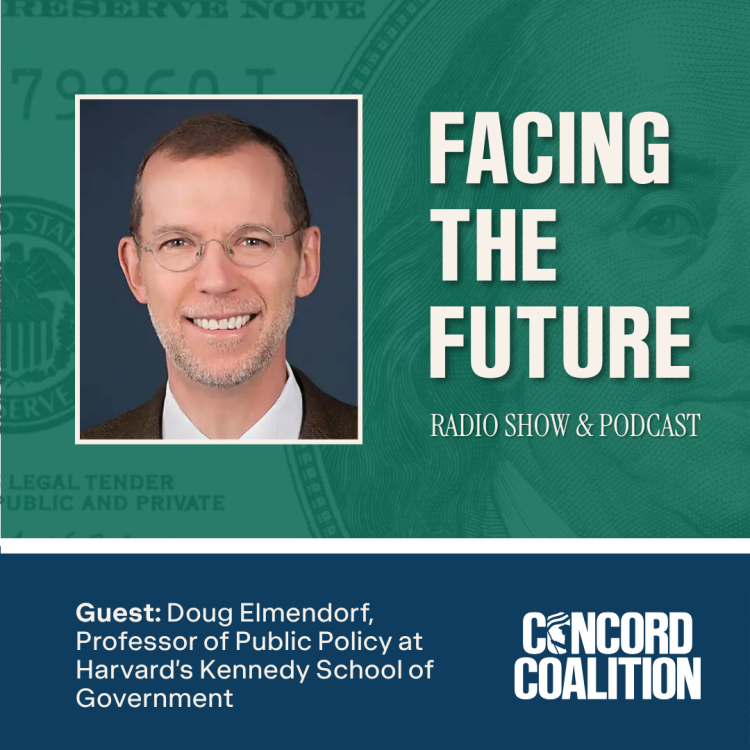
This week on Facing the Future former Director of the Congressional Budget Office (CBO) Doug Elmendorf of Harvard’s Kennedy School of Government discussed the state of the economy, the government shutdown and why policymakers should not rely on economic growth alone to rein in the unsustainable growth of debt. Concord Coalition Executive Director Carolyn Bourdeaux joined the conversation.
“The economy is, in some ways, very strong,” Elmendorf said. “We have an unemployment rate that is low by historical standards. We’ve had economic growth since the pandemic that is faster than economic growth rates in many other advanced economies. So there’s a lot of good news, but there’s also worrying news. The inflation rate is running well above the Federal Reserve’s target and really stopped coming down more than a year ago. There are reasons to think it would continue down, except that we now have tariffs that are pushing inflation up and the labor market seems weaker. The growth of jobs is way down.”
These mixed signals will all be in play later this month when the Federal Reserve meets again to decide whether to make a change in interest rates. Elmendorf outlined the competing factors, saying that, “the Federal Reserve indeed has a challenge. If it looked only at the inflation data, it would be inclined to hold interest rates or even raise them. If it looks only at the labor market data, it would be inclined to cut interest rates, and of course, it can’t both raise and cut at the same time, and so it will have to make a hard choice again this month, and presumably in December and beyond as well.”
The fact that federal agencies have been closed since October 1st because Congress failed to pass any of its annual appropriations bills on time adds more uncertainty to the economic outlook. “Shutdowns matter a lot,” Elmendorf said, “and I think that our policymakers are doing the nation a bad service by not recognizing how costly shutdowns are. Some of the cost is to the economy. When workers don’t get paid, then they can’t spend money, and that slows the economy at a somewhat perilous time. But I think the bigger issues are actually the disruption to the provision of government services. Moreover, it is so harmful to an organization to have a large set of its people not at work for some indeterminate period of time. And so I don’t feel like our policymakers take that disruption as seriously as I wish they would.”
Another thing Elmendorf would like policymakers to take more seriously is the growth trajectory of the nation’s debt. Absent serious changes in spending and tax policies (probably both), Elmendorf said that eventually the U.S. could end up in a fiscal crisis, which he described as “what happens when investors are unwilling to buy and hold government securities, government bonds, at typical interest rates.”
If that happens, he continued, “you end up in a situation where the government really has to make dramatic changes in spending and taxes, or tries to inflate the debt away, or defaults on the debt. All those outcomes are bad, so you don’t want to get to that point of a fiscal crisis.”
Elmendorf acknowledged that “economists cannot predict when that kind of crisis will occur. At any given moment we might be more likely to muddle through. But at some point, that won’t happen and it won’t be possible anymore. And so the right thing to do, the prudent thing to do, is to take action first. You don’t wait until you’re on the edge of the cliff to step back. And we should be stepping back.”
In that regard, he said that, “Break-glass plans are useful because we might actually need one, and also because the act of putting one together illustrates how much one would rather not be in that position. And so I think it can have a useful warning effect. If you’re riding a bicycle downhill and you see a brick wall at the bottom what do you do? Do you wait till you get there, or do you try to jump off now?”
Elmendorf also described a recent paper he co-authored with Glenn Hubbard and Zachary Liscow looking at policies that could reduce federal budget deficits by increasing economic growth. “What we find,” he said “is that regulatory policy changes are more likely to pay for themselves in the sense they don’t tend to have direct budgetary costs of any magnitude. And so, for example, if we relaxed some of the restrictions on permitting to build power lines or other sorts of infrastructure that would spur economic growth and reduce budget deficits to some extent, and there wouldn’t be much direct budgetary costs. Now, there could be other trade-offs. I want to be clear here. Those permitting requirements were put in place to protect the environment, to protect people who would be affected by infrastructure. So it’s not a free lunch.”
“Ultimately,” Elmendorf concluded, “this comes down to our elected representatives taking seriously the coming problems, and we can all help with that as citizens of the country. I think policymakers will be more concerned when people express more concern to them, meaning not just general worry, but a willingness to take some hard medicine to avoid the problems.”
Hear more on Facing the Future. Concord Coalition Senior Advisor Bob Bixby hosts the program each week on WKXL in Concord N.H., and it is also available via podcast. Join us as The Concord Coalition team discusses issues relating to national fiscal policy with budget experts, industry leaders, and elected officials. Past broadcasts are available here. You can subscribe to the podcast on Spotify, Pandora, iTunes, Google Podcasts, Stitcher, or with an RSS feed. Follow Facing the Future on Facebook, and watch videos from past episodes on The Concord Coalition YouTube channel.