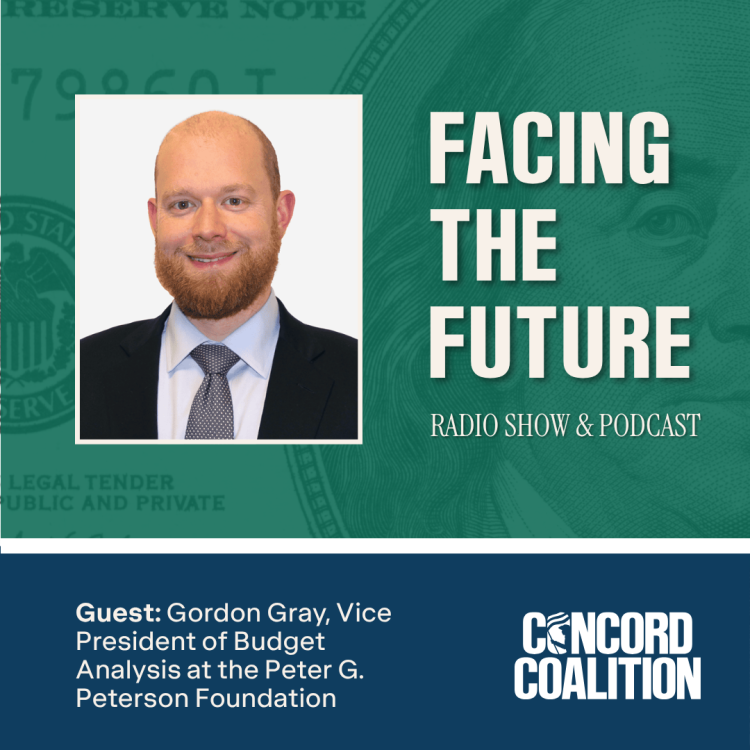
This week on Facing the Future, we looked at the federal government shutdown from a political and an economic perspective. Our guests were David Lerman, Editor of CQ Budget, who covers Capitol Hill, and Gordon Gray, Vice President for Budget Analysis at the Peter G Peterson Foundation, who tracks the economy. Both guests were critical of the tendency for policymakers in Washington to ignore obvious problems until they bloom into a crisis.
“September 30 is the end of this fiscal year,” Lerman said. “They knew what the deadline was, and they haven’t been able to meet the deadline. What normally happens is they pass these continuing resolutions meant to extend current funding until they get the final spending package done. This is a perennial problem but this year in particular, it’s really bad. Relations are so poisonous now, the politics are so heated, that they can’t even agree to pass a continuing resolution.”
He described a lack of trust and communication. “These guys don’t even talk to each other,” Lerman said. “They’re not willing to sit down at the beginning of the year and try to get an agreement on top-line spending levels so that the appropriators can do their thing. For whatever reason, they refuse to do that, and it is hard to do, which is why they tried to drag it out. You know, it’s just procrastination, really. They can’t get anything done until there’s a deadline facing them. And so here we are yet again. It’s only because of the lack of trust that this has become such a huge hurdle.”
Lerman also observed that a disagreement over the president’s authority to unilaterally rescind funds already enacted through appropriations bills (“pocket rescissions”) was an obstacle in negotiations to end the shutdown.
“This is fundamentally a big fight over the power of the purse,” Lerman said. “What really outraged Democrats is this pocket rescission where the White House notified Congress of its intent to claw back four to five billion dollars of foreign aid within 45 days of the end of the fiscal year. They’re claiming ‘we can just do it ourselves,’ and Congress won’t have enough time to act because the fiscal year will have expired and the money will have expired. So it’s a neat little trick. The problem is that the legality of that maneuver has never really been tested.”
Meanwhile, the unresolved questions about the legality of pocket rescissions are hanging over a budget deal. Lerman said Democrats were infuriated. “Their attitude is, ‘well, look, what is the point of negotiating these bipartisan spending deals if later the White House can just claw any money back it wants without congressional input … the whole deal collapses, and how can we trust them?’ It’s that same fundamental issue of trust,” Lerman said, adding that “we don’t see light at the end of the tunnel just yet.”
Gray, of the Peterson Foundation, was similarly pessimistic about the current situation. He noted that even before this shutdown political dysfunction was a factor in the decision of credit ratings agencies to downgrade the U.S.
“Distress in U.S. governance has been cited by rating agencies, so it has a direct bearing on our creditworthiness. Creditors don’t just look at dollars and cents.They look at the mechanisms that animate the spending and taxing and disposition of those dollars and cents. When you have a government that is obviously dysfunctional, creditors have good reason to doubt the U.S. creditworthiness. So that’s a very real risk,” Gray said.
“The textbook model of a crisis is essentially a failed Treasury auction,” he continued, “where there simply is not enough demand for treasuries. We have mechanisms in place to essentially force participation, and there’s always the Fed, but that signal would be unprecedented. It would be very, very damaging to global markets and the U.S. Treasury market in particular.”
Moreover, he said “when, financial instruments that ordinary Americans interact with, so their mortgage, car loan, consumer credit, become unmoored to historical levels that’s a particular pain point. So my concern is that a debt crisis in the U.S, would ripple through many channels that would harm hard working Americans who are most vulnerable. We’ve seen this in other countries. Those are the folks who will take it on the chin the hardest.”
Gray had this warning: “People want to know, ‘when do I have to care about this?’ By the time you’re staring down the barrel of a debt crisis, it’s too late! We are squandering the opportunity to solve this problem.”
Hear more on Facing the Future. Concord Coalition Senior Advisor Bob Bixby hosts the program each week on WKXL in Concord N.H., and it is also available via podcast. Join us as The Concord Coalition team discusses issues relating to national fiscal policy with budget experts, industry leaders, and elected officials. Past broadcasts are available here. You can subscribe to the podcast on Spotify, Pandora, iTunes, Google Podcasts, Stitcher, or with an RSS feed. Follow Facing the Future on Facebook, and watch videos from past episodes on The Concord Coalition YouTube channel.