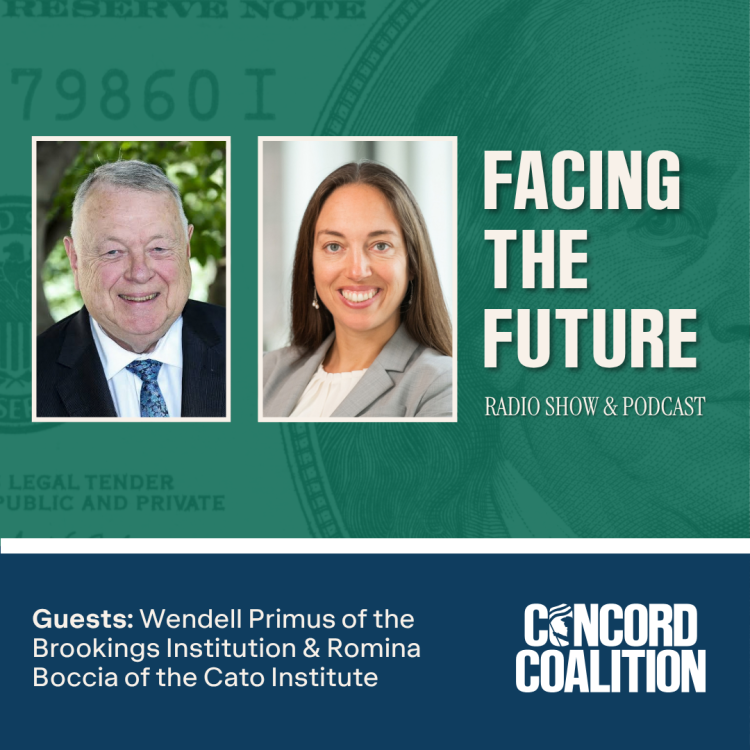
This week on Facing the Future, Romina Boccia, director of budget and entitlement policy at the Cato Institute and principal author of the Debt Dispatch newsletter, explained the economic dangers of ignoring the nation’s spiralling debt and suggested some Social Security and Medicare reforms that would help.
“The immediate risks include slower growth and higher interest rates that don’t just affect the U.S. federal government, but also spill over into higher mortgages, higher business loans, higher credit card interest rates, as borrowing becomes more expensive,” Boccia said. “You see fewer investments, you see less money being put towards startups and innovative new ideas, and so that also depresses future economic growth. In economics, we call that the‘crowding-out effect where, as the government sucks up more and more credit and does more and more spending, it reduces the ability for the private sector to make productivity-enhancing investments.”
“There’s also the potential for a more severe fiscal crisis,” Boccia warned. “Once investors lose faith in the federal government’s willingness or ability to service the debt without diminishing the principal value by inflating it away, they will demand much higher interest rates to compensate for that risk of higher inflation. That increases the cost for the federal government to borrow and drives up our interest costs. Interest is already projected to consume about a quarter of all revenues by the end of this decade, and the more our revenues go towards interest on the debt the more we have to borrow just to pay the interest and fund government programs. And so you can end up in a debt doom spiral where governments eventually come to rely on the printing press to make up for the fact that they can no longer borrow at sustainable rates.”
Boccia explained that it is not realistic to expect economic growth alone to be able to close the budget gap. “Economic growth is pretty much always beneficial so we should want more economic growth,” she said. “However, we cannot grow our way out of the entitlement-driven spending and debt crises because both Medicare and Social Security are designed to grow with or faster than the economy. The math doesn’t work. You can’t outgrow a program that’s designed to grow faster than the economy.”
She expressed concern that Social Security and Medicare already consume much of the federal budget with projections showing an even greater share going to these programs in the years ahead.
“The U.S. budget reflects the political strengths of seniors,” she noted. “More than 40 cents of every dollar the federal government spends goes towards benefits for the population 65 and older and the CBO projected that by 2029 50% of the non-interest federal budget would go towards financing benefits for the population 65 and older, who, by the way, make up around 17-18% of the population. So, the fact that they’re getting half of the budget transferred to them should raise some serious alarm bells.”
She called this wealth transfer the “Robin Hood Principle in Reverse,” where “younger, working Americans who generally have low net worth, because they haven’t had their entire lives to accumulate savings and assets, end up subsidizing the older generation, regardless of need.”
“This, of course, has implications for the future as well,” she pointed out, “because as we are fleecing younger working Americans, it is limiting their ability and willingness to form families. That means fewer workers for the United States economy in the future. Resources that are subsidizing consumption among the elderly are also resources that are not available for investment today, so we should expect slower economic growth as a result of this transfer as well.”
Boccia has researched how other countries have gotten out of fiscal difficulty. “The big takeaway,” she said “is that in most cases, it actually took a crisis for politicians to finally see the light and do something about it. And in most cases, a fiscal commission of independent experts was consulted, not just to provide guidance to the government for how to get out of the situation, but also to provide political cover to make those politically unpopular changes.”
The model Boccia favors for the United States is the Base Realignment and Closure Commission (BRAC), which succeeded at closing several obsolete military bases and saved the government hundreds of billions of dollars as a result.
“The reason it worked,” she said “was because it put in place independent experts and gave them goals that they needed to achieve – big picture goals, like stabilizing reducing the deficit to 3 percent of GDP, which is a current target that has been proposed – and Congress could blame the experts for any benefit reductions or tax increases that would be involved to reach those goals.”
The other component that made BRAC effective in Boccia’s assessment was that “if the Commission succeeded at achieving the goals that Congress set, then the recommendations would go into effect automatically, unless Congress voted to oppose them. That changed the default, where members of Congress didn’t have to vote to put the changes into effect but they retained the power to reject the Commission proposal. Changing that default setting is one of the most important parts of having an effective fiscal commission.”
Hear more on Facing the Future. Concord Coalition Senior Advisor Bob Bixby hosts the program each week on WKXL in Concord N.H., and it is also available via podcast. Join us as The Concord Coalition team discusses issues relating to national fiscal policy with budget experts, industry leaders, and elected officials. Past broadcasts are available here. You can subscribe to the podcast on Spotify, Pandora, iTunes, Google Podcasts, Stitcher, or with an RSS feed. Follow Facing the Future on Facebook, and watch videos from past episodes on The Concord Coalition YouTube channel.