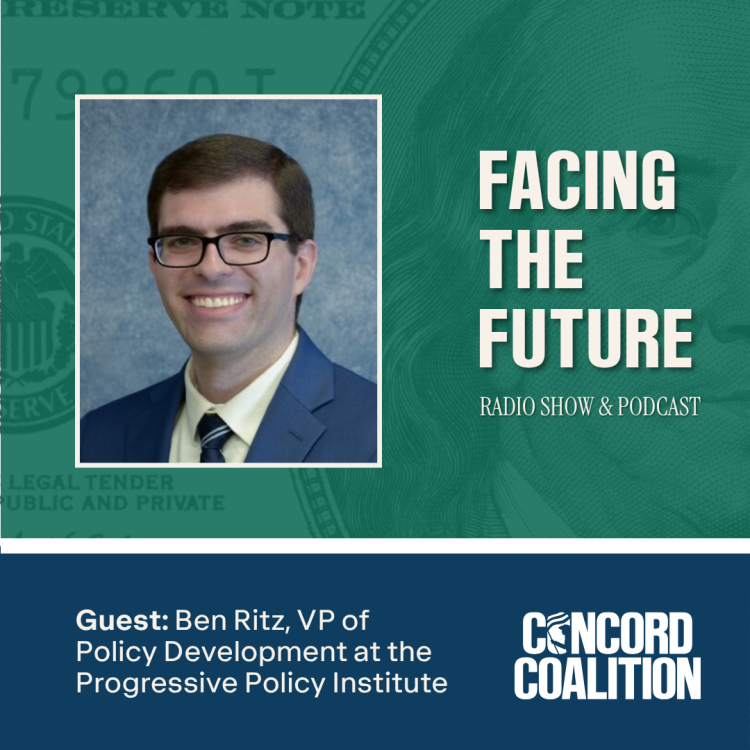
This week on Facing the Future, former Social Security Public Trustee Charles Blahous discussed the program’s deepening funding challenges on its 90th anniversary and explained why postponing action just makes things worse. Blahous served as a public trustee for Social Security and Medicare from 2010 through 2015. He is now Senior Research Strategist at the Mercatus Center at George Mason University.
Blahous is concerned that time is quickly running out to enact phased-in reforms to prevent Social Security trust fund insolvency, which the program’s Chief Actuary says will happen in 2032. The alternative, Blahous fears, is waiting until the trust fund is depleted and then bailing it out with general revenues, an outcome that would end Social Security’s special status as a “self-financed” government program.
“Social Security provides people with a pretty substantial amount of income,” Blahous said, “and it is only able to do that by collecting a pretty large amount of income, and yet it does it in a way that people generally find fair. It’s not like we all love paying the payroll tax, but the American public generally accepts it because they see the benefits of what they get out of Social Security. That’s a pretty remarkable political achievement.”
Blahous observed that “Social Security has security and reliability in its benefit structure that so-called welfare programs do not have” because welfare programs are funded out of the general budget. “We’re always relitigating the terms of exchange in those programs,” he said. “Social Security escapes that but only because of this financing structure where you get a job, you pay Social Security payroll taxes, they’re broken out separately on your pay stub, you see that, and the government’s telling you, we’re crediting it to the Social Security trust funds.”
“That only works.” Blahous warned, “as long as we are willing to align the program’s benefit structure with what workers’ tax contributions can actually finance. If we’re not willing to do that anymore, we can’t have this type of Social Security system. We’d have to have a very different type of system that was financed wholly or in part from the general fund, and we wouldn’t have this idea that workers had paid for their benefits, had earned their benefits.”
The fiscal consequences of supplementing Social Security with general revenues also concerns Blahous. “There is financing discipline in the current system. The system is obliged to either constrain benefit payments to the amount of incoming revenues, or raise incoming revenues to meet benefit obligations. But if you eliminate that discipline, suddenly the government pours out trillions and trillions of additional debt that statutorily it is not currently permitted to do. You’d have to change the law in order to bail the system out with this level of additional debt issuance. That’s obviously not going to be good for the federal budget, not going to be good for interest rates, not going to be good for inflation.”
Blahous described the general revenue option as an “easy way out, the path of least resistance, the lazy way out for people who don’t want to make the difficult choices.” But he said he has an even stronger objection on political grounds. “Suppose most Americans disagree with me. So be it. I don’t think that system will work as well, but we can make that decision. What I viscerally object to is that happening because politicians didn’t level with Americans that it was happening. Most Americans don’t know this is happening. They are not expecting, asking for, demanding this change in Social Security. And lawmakers are pretending it’s not coming. That’s an egregious dereliction of duty.”
“If we want to make this decision as a society to abandon what we’ve had to this point, so be it. I’ll argue no, but I could lose that argument. But it shouldn’t happen because people were duped. And that’s what’s happening now. People are being led to believe that the Social Security system they have it’s going to continue basically in the form that it currently exists, and that’s not the way lawmakers are acting. And that is, I just think, unethical.”
As a framework for substantive solutions, Blahous explained, “the problem is so big at this point, you can’t fix it all on the cost side, you can’t fix it all on the revenue side. So I start out by saying, you’re going to have to do revenues, you’re going to have to do moderation of benefit growth, you’re going to have to do eligibility age changes. I just simply do not believe lawmakers would be willing to do it all with one mechanism or the other at this stage. Just divide it up into three pieces and say, maybe not exactly in thirds from each piece, but at least start there, and then just see how much you want to distribute the types of changes.”
Hear more on Facing the Future. Concord Coalition Senior Advisor Bob Bixby hosts the program each week on WKXL in Concord N.H., and it is also available via podcast. Join us as The Concord Coalition team discusses issues relating to national fiscal policy with budget experts, industry leaders, and elected officials. Past broadcasts are available here. You can subscribe to the podcast on Spotify, Pandora, iTunes, Google Podcasts, Stitcher, or with an RSS feed. Follow Facing the Future on Facebook, and watch videos from past episodes on The Concord Coalition YouTube channel.